Collaborative Leadership in Special EducationA Five-Part Workshop Series for Principals and Building Leaders
Each 60-minute session is tightly focused on a specific leadership challenge principals face when collaborating with special education administrators, instructional staff, MTSS teams, counselors, school psychologists, and related service providers. The sessions are practical, leadership-oriented, and centered on improving coordination, communication, and implementation across school systems. David Bateman, PhD (pictured) is a nationally recognized expert in special education law, dispute resolution, and legal compliance. A former special education teacher and administrator, he has served as a due process hearing officer, complaint investigator, mediator, and neutral fact-finder in special education cases across the country. Dr. Bateman is the author and co-author of numerous leading publications on IEPs, Section 504, education leadership, special education law, and dispute resolution, including texts widely used by educators, administrators, and policymakers. He is a frequent keynote speaker and has led special education training and system improvement efforts for states and territories nationwide. He is also the parent of two adult children, one with an IEP and one with a Section 504 plan. If you are not currently a CASE member, the total cost to join CASE and register for this full webinar series is $385. After you join CASE, you save $624 on this registration when you are able to register as a member rather than a non-member. Your membership includes:
New Opportunity! District Team Recorded Series PackageBring Collaborative Leadership to Your District! Make professional learning accessible to your entire leadership team with the District Team Recorded Package for the Collaborative Leadership Series. Your team can learn together, revisit key strategies, and build a shared approach to collaborative leadership—all on your schedule. The full recorded series will be available for district use following the last session. The recorded sessions will be available through May 2026.One package. One team. Shared learning. Greater impact. September Workshop: Free offering open to allWhat Really Happens in Due Process: Lessons for Principals, Teachers, and District LeadersWhat happens when special education disagreements escalate into due process hearings? What do hearing officers actually focus on? What mistakes repeatedly appear in testimony and documentation? And what can school leaders do now to avoid becoming the next case study? Participants will review excerpts from real due process transcripts, analyze key moments where systems either succeeded or broke down, and discuss practical strategies for improving collaboration, decision-making, and defensibility.This session will provide honest discussion, practical lessons, and immediately applicable ideas for school and district teams.October WorkshopShared Leadership: Defining Roles and Responsibilities in Special EducationStrong special education systems begin with leadership clarity. This session focuses on the relationship between principals and special education leaders and examines how unclear roles often create conflict, inconsistent implementation, and fragmented decision-making within schools. Participants will explore how building leaders can create shared ownership of special education services while improving collaboration between general education and special education systems. Session Focus
November WorkshopSupporting Instruction Together: What Principals Need to Know About Specially Designed Instruction (SDI) and IEP ImplementationMany principals are expected to supervise special education services without ever being trained to recognize high-quality specially designed instruction (SDI). This session focuses on helping administrators better support teachers, co-teaching teams, and special education staff through stronger instructional leadership. The session emphasizes collaboration between principals, instructional leaders, and special education staff to improve implementation consistency across classrooms. Session Focus
December WorkshopDifficult Conversations and Collaborative Problem-SolvingSpecial education leadership often becomes most difficult during conflict. This session focuses on how principals and special education leaders can work together during challenging situations involving behavior, parent concerns, discipline, emotionally charged meetings, and disagreements among staff. Participants will examine how leadership communication either escalates or reduces conflict and will learn strategies for maintaining collaborative relationships during difficult situations. Session Focus
January WorkshopBuilding Sustainable Systems for Inclusion and AccountabilityThe final session focuses on how principals and special education leaders can create sustainable systems that improve outcomes for students with disabilities while supporting staff and reducing implementation breakdowns.Rather than focusing solely on compliance, this session examines how schools build accountability systems that improve instruction, communication, and inclusion over time. Session Focus
|
|||||||||||||||||||||||||||||||||||||||||||||||||||||||||||||||||||||||||
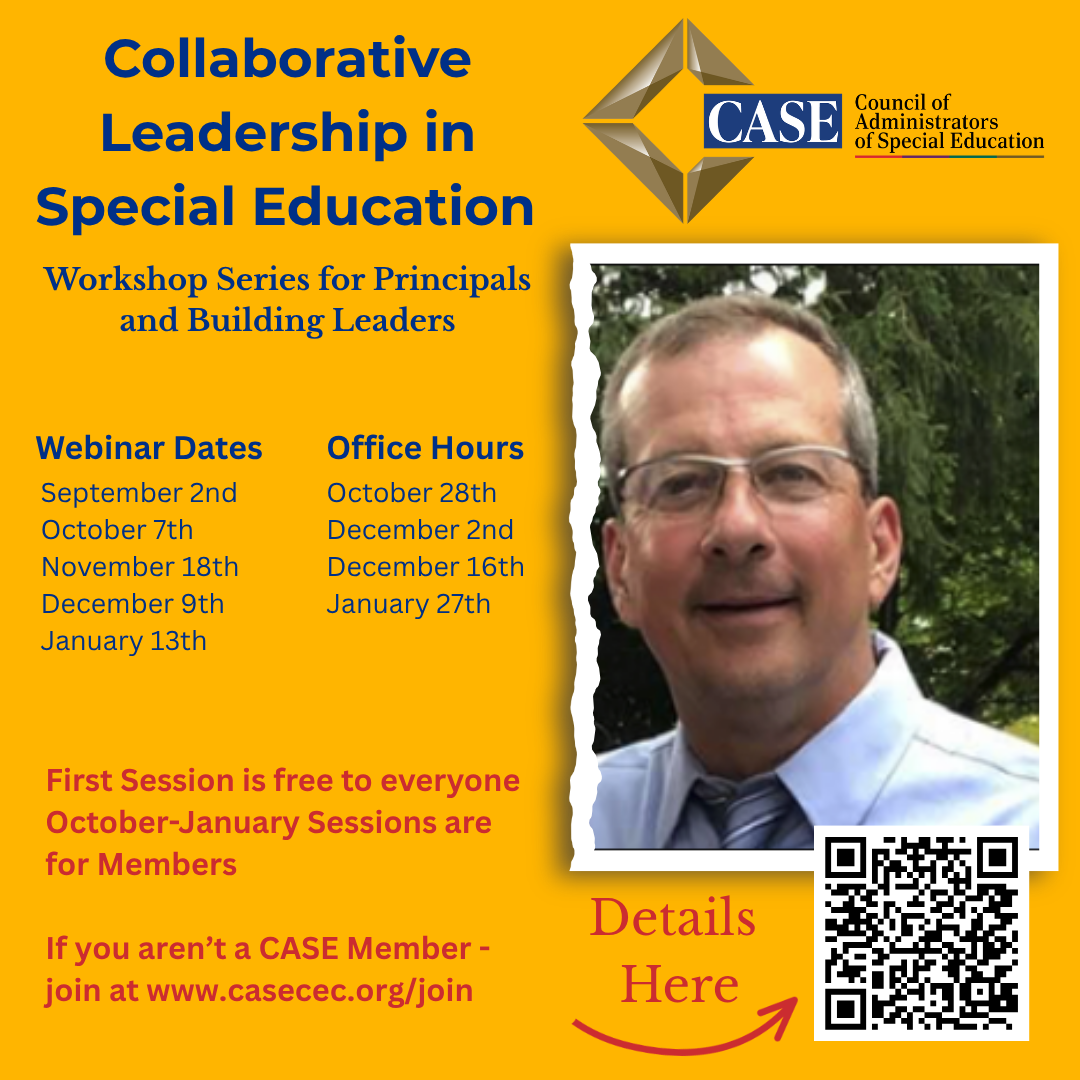 This five-part workshop series is designed specifically for principals and building-level leaders who are responsible for ensuring students with disabilities receive effective, legally compliant services under IDEA and Section 504. The series focuses on one of the most important realities in schools: special education works best when building leaders work together.
 Council of Administrators of Special Education (CASE)
1546 E. Bradford Parkway, Suite L100, Springfield, MO 65804© Copyright 2026. All rights reserved.
Privacy Policy